
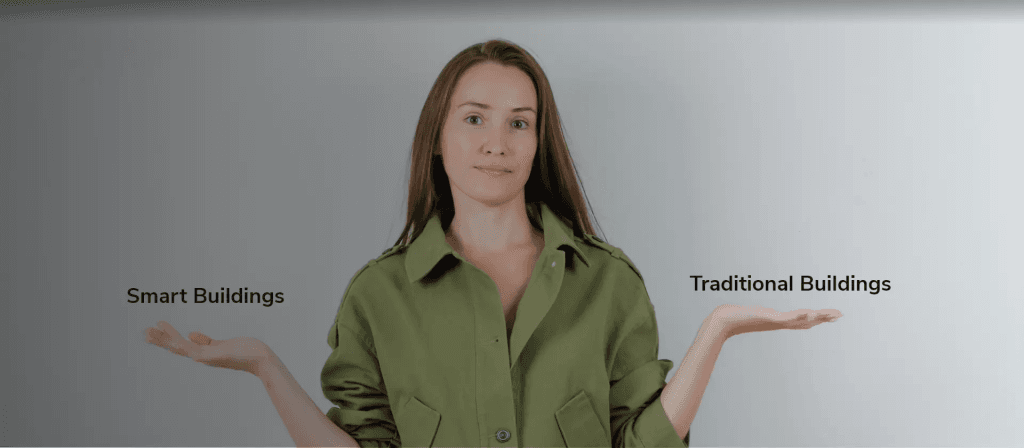
The advent of smart building technology has been a revolutionary phenomenon in the constantly changing real estate and construction market. These structures are more than just bricks and mortar; they are dynamic, intelligent building%3B%20people%20() systems that are altering the way we live and conduct business. These can be characterized by smart buildings' sensors and systems which enable integrated management of the building functions and improve the user experience.
But what distinguishes intelligent buildings from conventional ones? In this article, we will examine the key distinctions between the both. Let us illuminate how technology is changing the settings in which we live, work, and play. Let's embark on a quest to understand the cutting-edge capabilities and features that redefine the future of design and construction.
Smart Buildings Technology Vs. Traditional Buildings: A Comparison
 Budget, purpose, and long-term objectives are just a few of the numerous considerations that influence whether smart building technology or conventional architecture is best. While intelligent buildings present an alluring image of the future, traditional buildings have a more solid track record and can be initially more cost-effective. Let us now delve into the comparison between an automated building system and a traditional building.
1. Connectivity and Automation: Next-generation buildings are enabled with IoT (Internet of Things) sensors which interconnect every component in the building. This intricate web enables devices like lighting, HVAC (heating, ventilation, air-conditioning), temperature control, and security to communicate efficiently. These intelligent building systems automate and monitor controls and optimize sensors based on their usage, thereby reducing manual intervention.
On the other hand, traditional buildings are not enabled with IoT devices and lack this intricate building automation system, thus relying on manual controls and isolated systems.
2. User-Centric Experience: Smart building technology offers a personalized experience for occupants, making it user-centric. The IoT sensors read and analyze data for predictive maintenance and to optimize intelligent building systems according to the requirement. With the occupants in mind, smart buildings personalize temperature, control lighting based on occupancy, and utilize space efficiently.
Traditional buildings may have these basic amenities but the automation of devices for a tailored experience cannot be attained.
3. Remote Monitoring: Another feature that comes with smart building technology is the ability to monitor your space remotely. With app-based mobile monitoring, occupants can keep a watch on their property, operate IoT devices, and keep security in check. With traditional buildings, remote monitoring is not possible, which makes them more susceptible to robbery and other security issues.
4. Cost Efficiency: Apart from offering improved occupant comfort, better user experience, and security, these buildings are also cost-efficient when it comes to energy consumption and operational costs. The energy-efficient systems that predict and adjust the HVAC devices according to the weather and requirement, predictive maintenance, and reduced downtime result in lower operating costs by up to 40%, thus offering long-term savings. However, traditional buildings have lower initial costs, intelligent buildings can be heavy on the pocket initially and thus compel people to stick to the conventional setup.
5. Energy Efficiency: Smart building technology excels at energy conservation and is thus named as Green Building Technology. To reduce energy consumption, these buildings adjust to human behavior and ambient conditions using clever energy management sensors and data analytics. Futuristic buildings use predictive maintenance to detect anomalies and send alerts before the breakdown, which prevents operational costs as well. Traditional buildings cannot match this level of optimization, despite making improvements in energy efficiency.
What are the Major Challenges in Transforming to Smart Buildings?
 The transformation of traditional buildings into intelligent buildings is a complex process that might present various barriers. Here are some of the key challenges faced while transforming a traditional building into an intelligent one:
1. Financial Challenge: Upgrading a traditional building to an intelligent building system requires retrofitting the architecture with IoT devices such as sensors and automation systems, which levies a heavy initial investment. Traditional buildings also require infrastructure upgrades to support smart technologies, increasing the cost further.
2. Compatibility: Conventional building structures often feature legacy electrical and mechanical systems that may not seamlessly integrate with modern smart building solutions. The installation of new building automation systems can be intricate and expensive. In addition, residents will require education on how to adapt to these integrated building systems and utilize them to their fullest potential.
3. Technological Challenges: While energy efficiency is an objective of smart buildings' design, achieving it during the transformation from a traditional building can be difficult. To achieve current efficiency regulations, conventional buildings may need significant energy renovations, such as new windows, energy-efficient HVAC systems, IoT sensors, and insulation modifications which also results in higher costs.
4. Scalability: Transforming a building into an automated system is not sufficient. It's essential to ensure that IoT intelligent building systems are future-ready, enabling easy expansion and adaptation. A smart building management system is designed to be future-proof as part of forward-thinking architecture, simplifying the integration of new technologies as they emerge. This ensures that technology can evolve in sync with the evolving needs of a smarter building system.
5. Privacy and Security: Next-generation buildings can offer security to the residents through remote monitoring, the increased data collection can also lead to privacy and security issues. Building owners must create data privacy rules for online dangers and oversee the responsible handling of data. This entails safeguarding system access, encrypting information and routinely updating software and firmware to fix flaws.
Sum up
In the end, the key to ultimate user comfort is to combine the time-tested practices of traditional construction with the connectivity and efficiency of smart buildings. To overcome the obstacles of transforming traditional buildings into smarter buildings, a well thought out plan, a diversified team of professionals, and a thorough comprehension of the particular needs of the building are necessary. Collaboration with technology vendors, integrators, and cybersecurity experts is also crucial to overcome any technological or organizational challenge.

