
Legacy systems are the relics of the past or an essential tool in the digital world? This blog aims to enlighten users on the concepts of using redundant systems and their adverse effects on their continued usage in a world driven by technology. Do they hold any significance in the tech-driven world? Should you ransack your inventory and look for such systems and their modernization? Let us read more.
Understanding Legacy Systems:
Legacy system meaning: They refer to outdated technologies, software, or applications. They continue to be influential and of use in various industries despite their age and limited applications. These systems entail challenges in fitting into the typical tech-driven era. Their obsolete architecture poses us with questions if they are relevant or outdated.

Legacy systems examples If we try to date the example back to the non-digital era with a manual checklist containing data over decades… How do you track them down? How complex and tedious is the mere process of retrieving data from the database be?
Now, how do you track down those registers? How complex and tedious would the mere process of retrieving data from the database be? How would you track back in time to search for a specific person? How about their IDs and the photocopy of the IDs that you took a decade back?
Speculating is indeed difficult, but one must marvel at the dedication of the employees while also considering the time wasted in handling such strenuous data.
- Consider stepping into new and progressive data management by using Microsoft Excel to manage several pages of inventory data. The system itself is not outdated yet sees its application in several industries even now.
- Another example of a legacy system is the use of mainframe computers in large corporations. It managed each operation process and deposition of vast amounts of data. An array of sheets and presentations in several folders put the cumulative data in the center of the building O&M. These old computer systems are still in use today due to their reliability, scalability, and ability to handle mission-critical tasks.
- Some organizations categorize a few older versions of enterprise resource planning (ERP) software, such as SAP R/3 or Oracle E-Business Suite, as legacy solutions. There is a huge list of legacy ERP systems that are in use! Despite the onset of new ERP systems, companies are unwilling to invest in the ordeal of legacy migration to the cloud. A migration that would cut a dent in their pockets as they presume! Or does it happen?
- Consider the use of traditional landline telephone networks based on copper wire infrastructure to the VoIP (Voice over Internet Protocol). A model that ensures stable connectivity in remote or rural areas where internet connectivity may be spare or irregular.
Read more on types of legacy systems here.
Why are legacy systems still in use?
Some organizations, particularly in the health, government, and finance sectors have strict regulatory requirements. Due to this, they continue to leverage legacy operating systems.
1. Familiarity and comfort: Organizations often resist change, sticking to familiar systems that have served them for years. The fear of compatibility with specialized software or concerns about data safety and data migration will prevent them from making momentous decisions.
2. Investment challenge: To go a full detour, organizations must reevaluate the cost and effort required for a complete reinvestment in the new system. Extra expenses off the budget chart that the business did not anticipate. A move that small businesses cannot take without meticulous calculations.
3. Mission-critical functions: There is a possibility that these redundant systems might be intricately linked to critical business functions. The switch, migration, or integration to a modern system is indeed a pain-stalking process that might take days for accurate data transfer. Which will further lead to overseeing the process as complex or unnecessary.
What Does the Future Hold for Legacy Systems?
Legacy solutions do retain a permanent space in the organization's infrastructure. Their limitations are indeed becoming increasingly evident as an increasing number of progressive systems are coming into place. Security vulnerabilities, outdated technology, and scalability issues are the troubles of the present.
The unavailability of spare parts and inadequate training of technicians in new systems pose several maintenance challenges. So, what is the solution?
Even though there is the comfort of stability and familiarity in using a legacy system, legacy modernization is the need of the hour. Digital transformation facilities and the digitization of assets are the key attributes of smart spaces, transforming how buildings function.
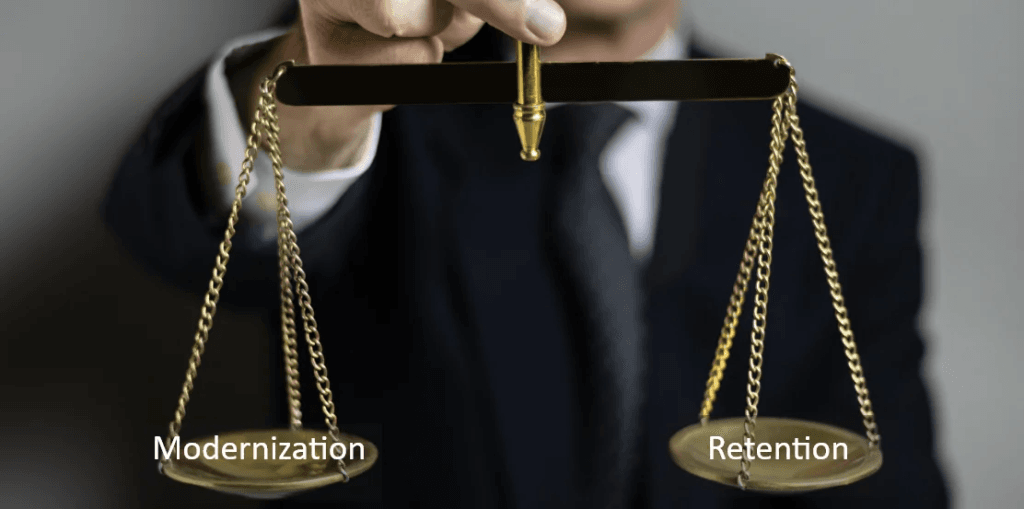
The act of balance - modernization vs. retention
Data migration is crucial for organizations to embrace modernization. Legacy systems may not be programmed to handle security threats and malfunctions strategically. New systems are well-programmed to handle data migration without data loss. They are masters at integrating with these systems to ensure continuity and minimize disruption during the transition.
The older the system, difficult the transition.
Considering the specific concerns, potential benefits, and prerequisites of migration, go ahead and take that leap! Legacy solutions are not going extinct and are here to stay. Might as well find a liable solution to work around the challenges and also look for building management systems that help in asset digitization of such systems.
Learn how to utilize legacy modernization and app modernization to stay ahead of the business curves. The key takeaway is to modern systems that can be modernized. Then, retain systems that work finely, as long as they are not a threat to the business or its processes.

