
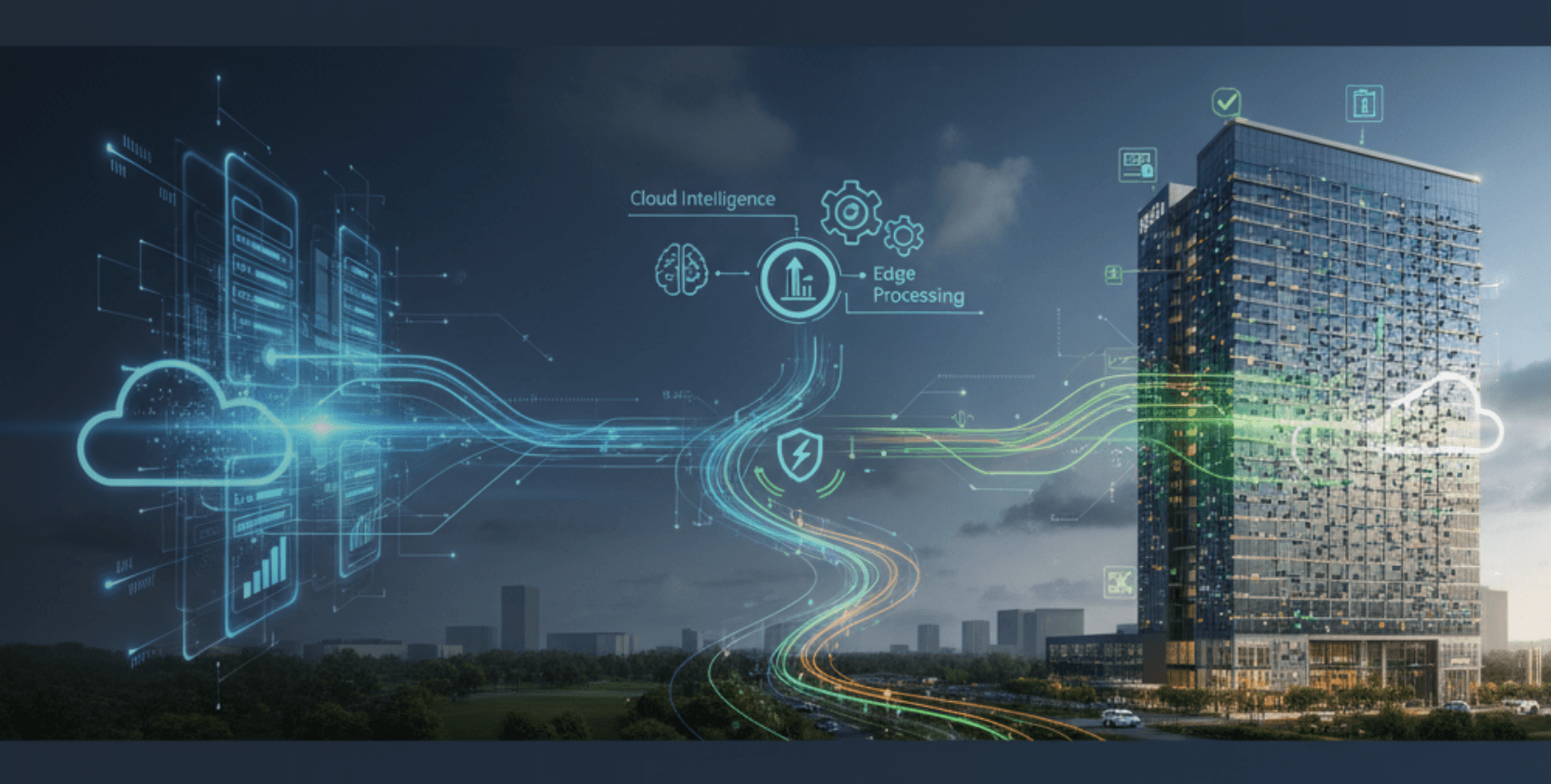
Delays lead to unwelcome effects on business operations. Despite being a boon, cloud computing has its limitations due to an exponential increase in the Internet of Things (IoT). Cloud-to-edge computing focuses on proactive, intelligent operations that increase speed and improve efficiency. By bringing computation to the data source, we unlock key insights that enable managed control over building systems. This technological advancement is especially essential for modern predictive facility management, where preventing issues is paramount.
Consider a large commercial building with thousands of sensors monitoring everything under the radar, from HVAC performance to elevator function. Transmitting all that data to a distant cloud for analysis causes lags. For instance, if a critical pump is on the verge of failure, the time taken to receive a cloud alert can be the difference between a minor repair and a catastrophic system shutdown. This is where edge computing processes data locally to provide real-time alerts and automated responses. Organizations are assured of operational continuity, saving significant costs.
Cloud-to-edge transition isn't about replacing the cloud but enhancing it. The edge cloud model creates a potent partnership where the edge handles immediate, time-sensitive tasks, while the cloud manages large-scale data analysis, long-term storage, and machine learning model training. This hybrid approach offers the best of both worlds: the speed of local processing and the power of centralized intelligence. As a result, facility managers can optimize resource allocation and promote asset longevity, transitioning from a reactive maintenance schedule to a predictive one.
From Cloud to Edge: Redefining Real-Time Facility Insights
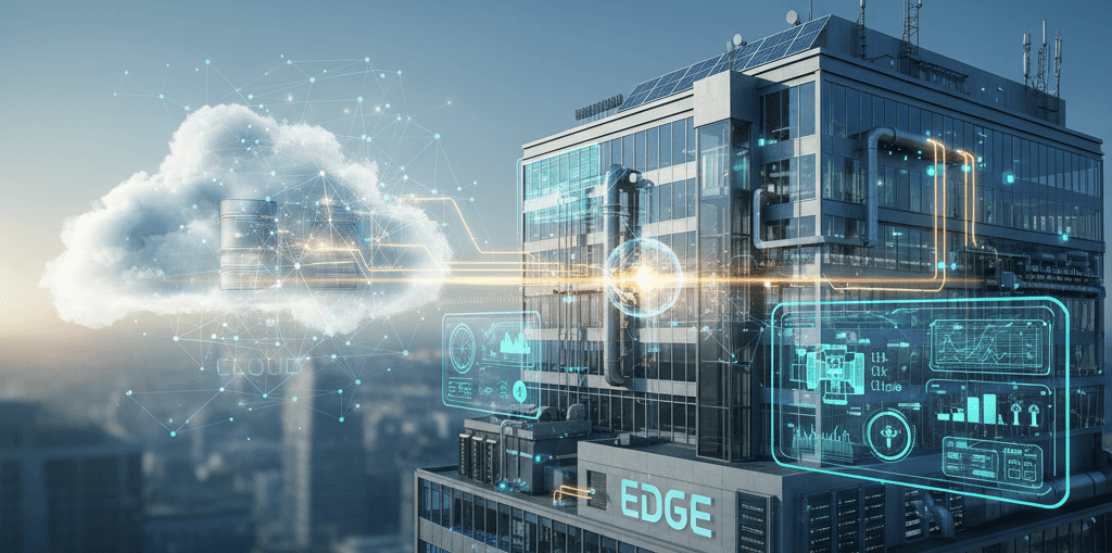 Modern building leveraging cloud-to-edge technology with digital connections, transferring data from the cloud to on-site edge systems for faster decision-making.
Traditionally, facility management relied on scheduled maintenance and damage control after failures. The adoption of cloud to edge marks a fundamental change in terms of building infrastructure. Cloud computing enables sophisticated data collection, but latency proves to be a challenge. By integrating edge computing technology, we empower facility managers with the tools to anticipate problems with remarkable accuracy, transforming building operations from ground zero.
This decentralized approach offers several key advantages that directly impact a facility's bottom line and operational resilience. By processing data on-site, organizations can detect anomalies in milliseconds, reduce their reliance on constant internet connectivity, and enhance data security by keeping sensitive information local. The result is a smarter, more responsive, and efficient building ecosystem.
Why is local processing crucial in predictive facility management?
An edge device, generally a nearby server or a gateway, processes data locally. One of the most compelling edge computing use cases is real-time anomaly detection. Instead of streaming endless data to the cloud, smart sensors and local gateways can analyze information as it's generated. This capability is important for predictive facility management, where early warnings can prevent costly downtime.
• Reduced latency: Processing data at the source eliminates the round-trip delay to a central server. For a critical system like a hospital's power generator, an immediate alert about a voltage fluctuation is non-negotiable. Edge devices can identify this deviation instantly and trigger an automated response, like switching to a backup source, without human intervention. • Improved uptime: With IoT edge analytics, algorithms running on-site can monitor equipment vibrations, temperature, and energy consumption. They can predict a motor failure proactively by monitoring subtle changes in its operational patterns. This allows maintenance teams to schedule repairs during planned downtime, avoiding unexpected and disruptive breakdowns. • Enhanced bandwidth management: A single smart building can generate terabytes of data daily. Sending all this information to the cloud is not only expensive but can also strain network bandwidth. Edge computing filters this data, sending only relevant summaries or critical alerts to the cloud, optimizing network traffic and reducing costs.
Bridging Edge and Cloud Intelligence through Sclera
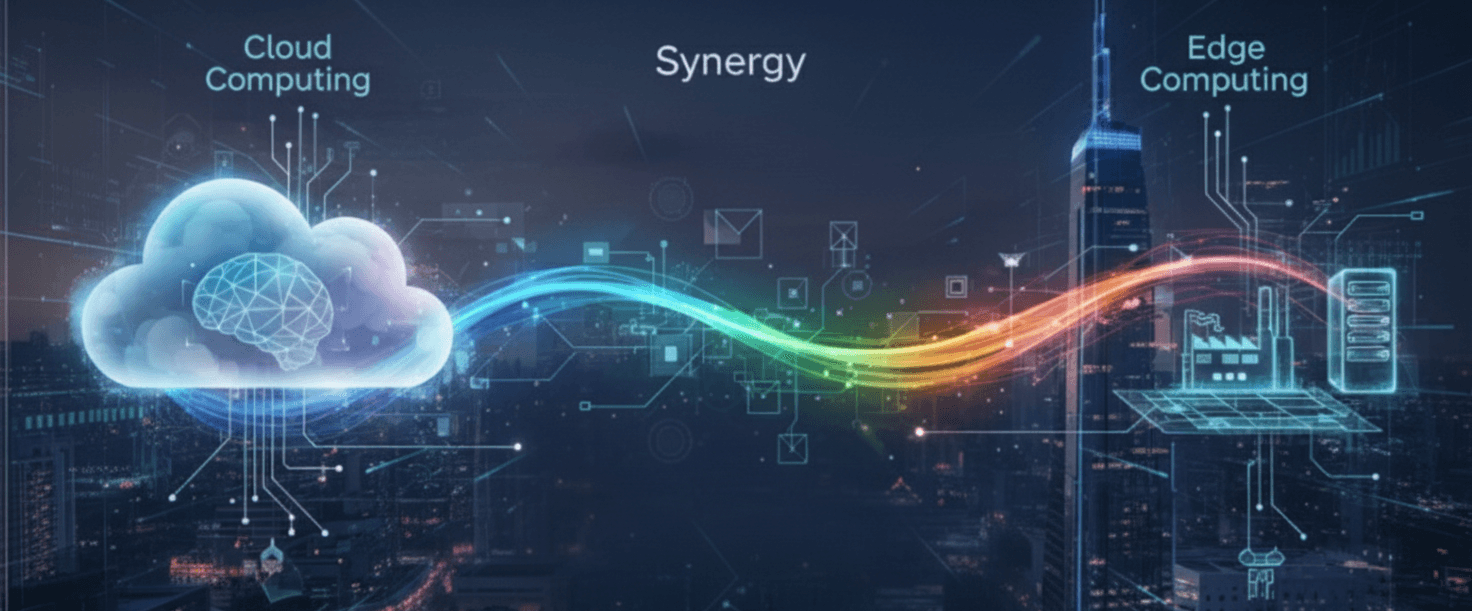 Cloud-to-edge synergy concept illustrating seamless data exchange between cloud computing and edge infrastructure in a connected smart city environment.
At Sclera, we understand that the future of intelligent facilities lies in a systematic edge-cloud architecture. Our platform is designed to employ the strengths of both edge computing and cloud computing. It deploys smart agents at the edge, right next to your critical assets, to perform real-time monitoring and IoT edge analytics.
This powerful edge computing technology enables Sclera to identify operational anomalies as they occur. For example, if an HVAC unit starts consuming more energy than usual, the edge agent detects it immediately, identifies the inefficiency, and can even trigger an automated adjustment. Only the essential data and insights proceed to the Sclera cloud for deeper analysis, trend reporting, and predictive model upgradation. This synergy ensures that facility managers receive instant alerts for urgent issues while also benefiting from long-term strategic insights to improve overall operational efficiency.
From Cloud to Edge: The Next Frontier in Facility Management
Efficiency is achieved when a strategy is applied intelligently. The cloud-to-edge transition is helping organizations zero in on predictive capabilities desirable for modern facility management. A paradigm shift from cloud to edge encourages local data processing, attaining speed and reliability. In turn, facility managers can extend asset life and reduce operational costs.
However, the synergy between edge and cloud is the foundation of the next generation of smart buildings. While cloud computing can be utilized for a heavier data load, flexibility, and scalability, edge computing can give organizations a competitive advantage. As IoT devices are gaining momentum, anomaly detection assists in preventing potential malfunctions. IoT edge analytics improves security and reduces bandwidth by filtering out irrelevant data.
Sclera helps in this transformation by providing the necessary tools to build resilient and intelligent operations. By embracing the hybrid model of edge computing and cloud computing, organizations can future-proof the facilities domain and build a data-driven strategy that relies on predictive capabilities.

